Best South Austin Duplex Investment Areas to Consider
If you are thinking about buying a duplex in South Austin, one zip code will not tell you enough. This market works more like a ladder, with lower-entry areas that can look better on rent-to-price and inner-south neighborhoods that tend to attract buyers focused on long-term positioning. If you want to know where to look first, what tradeoffs to expect, and which pockets fit your goals, this guide will help you narrow the map. Let’s dive in.
South Austin is not one uniform duplex market. Current home value data shows a wide spread, from about $328,488 in 78741 to about $722,362 in 78704, with 78745 at $425,310, 78748 at $414,900, and 78749 at $555,241.
That price spread creates two broad paths for duplex buyers. You can focus on lower-entry areas where rent-to-price looks more favorable, or you can target closer-in neighborhoods where appreciation, owner-occupancy appeal, and resale strength may matter more over time.
Supply is uneven too. Current duplex and triplex inventory is deepest in Travis Heights, 78704, 78745, and 78741, while 78748 is thinner and 78749 is a very limited search. That matters because your best market on paper is not always the easiest one to shop in real time.
If you want the broadest mix of price, inventory, and practical layouts, 78745 is a strong place to start. The zip averages about $425,310 in home value and about $1,795 in average asking rent, with 19 duplex or triplex results and additional options in Garrison Park.
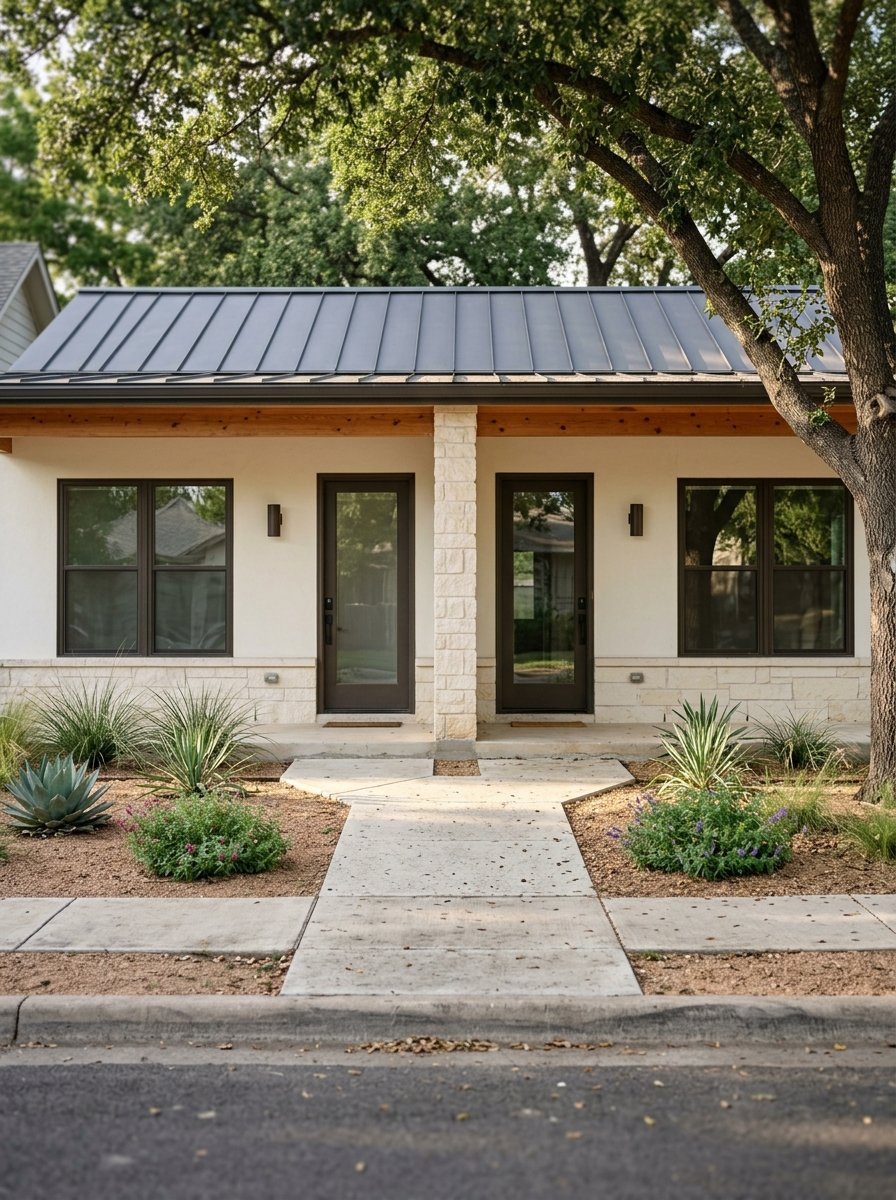
This part of South Austin tends to offer a balanced search. You will find older half-duplexes, newer infill product, and a range of layouts that often include garages, fenced yards, and functional two- and three-bedroom floor plans.
Neighborhoods like South Manchaca, Garrison Park, Westgate, and nearby South Lamar-adjacent areas sit in a middle band. They are generally more attainable than the premium inner-south neighborhoods, but they still feel established and practical for both owner-occupants and investors.
If your first priority is keeping your basis lower, 78741 deserves a close look. It has the lowest average home value among the core South Austin zip codes in this report at about $328,488, with average asking rent around $1,648 and 11 current duplex or triplex results.
This pocket supports more of a yield-oriented story than the pricier inner-south neighborhoods. Active inventory often includes larger buildings, with configurations such as 4/4 to 6/8 and sizes roughly from 1,700 to 3,600 square feet.
For buyers comparing rent potential against purchase price, 78741 is often one of the more compelling zones in South Austin. It may not carry the same premium feel as 78704, but it can make more sense if numbers drive your search.
If you care most about close-in location, owner-occupancy appeal, and long-term resale positioning, 78704 is the premium play. The zip averages about $722,362 in home value and about $2,250 in average asking rent, with active duplex and triplex inventory in Travis Heights, 78704 overall, and South Lamar.
This is usually not the easiest place to underwrite for immediate cash flow. Prices are much higher, and active inventory often skews renovated, larger, or more design-forward, with asking prices commonly starting in the mid-$600,000s and moving well above $1 million.
Within 78704, there is still a range. South Lamar can act as a bridge pocket, with an average home value of about $523,630, while Zilker and Barton Hills sit much higher at roughly $876,000 to $882,000.
If you want more yard space, easier parking, and a lower-density feel, 78748 is worth considering. The zip averages about $414,900 in home value and about $1,797 in average asking rent, but current duplex and triplex supply is limited at just 4 results.
This is a smaller market, so patience matters. When inventory does come up, buyers may find layouts that prioritize garages, outdoor space, and practical daily living over walkability.
For some buyers, that tradeoff is exactly the point. If you want a duplex that feels easier to live in and easier to lease because of parking and space, 78748 can be a smart niche target.
78749 is not a broad duplex hunting ground right now. It averages about $555,241 in home value and about $2,300 in average asking rent, but current supply is extremely limited, with just 1 duplex or triplex result in the report.
That means you should treat 78749 more as a selective opportunity than a full search strategy. If a well-located half-duplex becomes available, it may fit a buyer who wants a longer hold and plans to live in one side or prioritize stability over volume of choices.
In other words, 78749 is less about comparison shopping and more about waiting for the right property.
The best place to buy a duplex in South Austin depends on what you want the property to do for you. Price point, inventory depth, and likely renter appeal all vary meaningfully from one pocket to another.
Here is a simple way to frame the search:
| Goal | Best-fit areas | Why it fits |
|---|---|---|
| Lower entry price | 78741 | Lowest average home value among core South Austin zips in this report |
| Balanced search | 78745 | Good mix of inventory, attainable pricing, and practical layouts |
| Long-term positioning | 78704 | Stronger close-in appeal and premium resale profile |
| More space and parking | 78748 | Useful for buyers who value yards, garages, and functionality |
| Niche owner-occupant hold | 78749 | Limited supply, but can fit selective long-term buyers |
Average asking rents in the report are about $1,648 in 78741, $1,795 in 78745, $1,797 in 78748, $2,250 in 78704, and $2,300 in 78749. These figures are zip-wide averages, not duplex-only rents, so they are best used as directional signals rather than exact underwriting inputs.
Even with that limitation, the pattern is useful. On a simple rent-to-price basis, 78741 and 78748 look stronger, while 78704 looks weaker if you are focused only on immediate cash flow.
That does not make one area better than another across the board. It just means you should be clear about whether you are buying for monthly performance, long-term appreciation, owner-occupancy, or some blend of all three.
A neighborhood can look ideal until you realize there are very few duplexes available. Current supply is deepest in Travis Heights, 78704 overall, 78745, and 78741, while 78748 and especially 78749 offer a much narrower pool.
That affects how you should search. If you need options and want to compare multiple properties, 78745 and the 78741 corridor may give you a more practical runway than the far-south edge.
It also affects timing. In thinner submarkets, the right duplex may be worth waiting for, but you should expect less direct comparison and fewer comps in the moment.
Transit access tends to matter most near South Lamar, South Congress, East Riverside, and Ben White-adjacent locations. CapMetro Rapid service includes 801 on North Lamar and South Congress, 803 on Burnet and South Lamar, and 800 on Pleasant Valley, with the South Congress Transit Center at 301 W Ben White Blvd.
For duplex buyers, this can support renter appeal in practical ways. Areas with easier access to major corridors often attract more day-to-day interest from tenants who value commuting options and connectivity.
That does not mean every duplex near transit performs the same way. It does mean location within the zip code matters, especially when two properties look similar on paper.
Not every duplex competes the same way, even within the same neighborhood. In the current South Austin market, some features show up again and again because they improve day-to-day livability and leasing appeal.
Prioritize these traits when you compare properties:
These details matter in 78745, 78741, and 78748 in particular. In many cases, the duplex that feels easiest to use is also the one that is easiest to market later.
Zoning matters if you are evaluating a duplex for current use or future flexibility. Under Austin’s HOME Phase 1 amendments, the city allows up to three housing units on SF-1, SF-2, and SF-3 properties, and for duplex, two-unit, and three-unit uses, maximum building coverage is 40% and maximum impervious cover is 45%.
The city also states that each dwelling in two-unit and three-unit uses needs a unique address. It is also important to remember that deed restrictions can still override zoning.
That means you should not rely on zoning headlines alone. Property-specific review still matters when you are comparing lots, existing improvements, and future plans.
Recent year-over-year value changes in the report show a softer market across South Austin, but not a uniform one. 78741 is down 8.9%, 78748 is down 6.4%, 78745 is down 6.1%, 78749 is down 5.5%, and 78704 is down 5.1%.
For buyers, that creates an opening to be selective. You can compare neighborhoods more carefully, push harder on property quality, and think through whether you want a lower-entry duplex or a stronger close-in address.
In practical terms, the choice often comes down to this: do you want stronger rent-to-price today, or do you want a premium South Austin location that may support owner appeal and resale over the long run?
If you are sorting through South Austin duplex options and want a clear, neighborhood-level strategy, working with a local team can save you time and help you focus on the right pockets. For guidance on central duplex opportunities, off-market possibilities, and South Austin micro-markets, connect with David Grimes.
Stay up to date on the latest real estate trends.